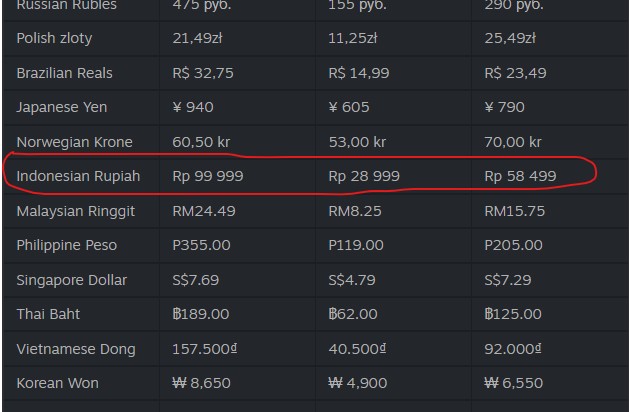
What a breath of fresh air today, Steam releases data on gamers’ purchasing power in Indonesia which might tell game publishers that Indonesians sometimes rarely buy games because they are too expensive. In an economy like this, can a gamer afford to buy newly released games? Of course not!
Valve has released Steam Pricing Tool and there is our beloved country, Indonesia, which shows an average purchase of only a third of the price of games on the global market. This means that a game that sells for $60 on the world market, in terms of purchasing power, is equivalent to three times the economic burden for most Indonesian gamers. In the pricing table section there are also other countries such as Malaysia, the Philippines, and many other countries.
From our point of view, Steam continues to maintain loyalty to its customers by making these tablets so that game developers and publishers know the wallet capacity of gamers in Asian countries, especially when it comes to new games of this genre. AAA which was certainly very expensive at the start of its release.
Usually, most gamers are less interested in buying games, they instead turn to a more sideways route, such as downloading games on pirated websites, or buying injected games on e-commerce, which is of course much cheaper.
This trend is in line with global data from GameDiscoverCo which shows that Steam players in general now prefer it low-priced games in the $5–$15 range. The median price of the best-selling game on Steam even fell by 20 percent from $19.50 to $15.64 between early 2023 and October 2025.
Again, gamers are currently having a very hard time buying games, especially with the prices being very expensive. Of course, in an economy like this, gamers are looking for entertainment through cheap games, even waiting for certain discounts from Steam. and hopefully Steam’s newest pricing tools can open the eyes of devs and publishers to sell games much cheaper, which of course means there will be far more Indonesian gamers because they follow increasingly sophisticated technological developments, of course.
PakarPBN
A Private Blog Network (PBN) is a collection of websites that are controlled by a single individual or organization and used primarily to build backlinks to a “money site” in order to influence its ranking in search engines such as Google. The core idea behind a PBN is based on the importance of backlinks in Google’s ranking algorithm. Since Google views backlinks as signals of authority and trust, some website owners attempt to artificially create these signals through a controlled network of sites.
In a typical PBN setup, the owner acquires expired or aged domains that already have existing authority, backlinks, and history. These domains are rebuilt with new content and hosted separately, often using different IP addresses, hosting providers, themes, and ownership details to make them appear unrelated. Within the content published on these sites, links are strategically placed that point to the main website the owner wants to rank higher. By doing this, the owner attempts to pass link equity (also known as “link juice”) from the PBN sites to the target website.
The purpose of a PBN is to give the impression that the target website is naturally earning links from multiple independent sources. If done effectively, this can temporarily improve keyword rankings, increase organic visibility, and drive more traffic from search results.